
AREA15 Las Vegas: An Immersive Entertainment District Between Art, Technology, and Social Experience


Las Vegas is known for extremes: neon lights, casinos, and spectacle-driven entertainment. AREA15 Las Vegas immersive entertainment sits just minutes west of the Strip, offering a deliberate contrast to the city’s well-known extremes of neon light, casinos, and spectacle-driven shows.
AREA15 is neither a traditional theme park, nor a museum, nor a shopping mall. Instead, it operates as a hybrid space: a social and cultural melting pot where immersive art, technology-driven attractions, food, nightlife, and live events coexist. This ambiguity is not a weakness—it is the core of its relevance.
AREA15 Las Vegas as an Immersive Entertainment District
Opened in 2020 and located west of Interstate 15, AREA15 was conceived as a platform for immersive experiences. It brings together large-scale installations, technology-enabled attractions, gastronomy, and live programming within an architectural framework that is itself part of the experience.
With already a few million visitors since opening, AREA15 has established itself as an alternative to the classic Las Vegas offering—not as a counterpoint, but as a complementary ecosystem.
The project was developed by the New York–based real estate company Fisher Brothers in collaboration with the creative agency Beneville Studios and additional investors.
One of the initiators, Winston Fisher, described AREA15 as a response to the structural shift in retail and the growing relevance of the experience economy. The underlying assumption: traditional malls do not need renovation—they need reinvention.
Experience Economy describes a business model in which companies no longer focus solely on products or services, but deliberately create experiences that resonate emotionally and generate value beyond pure functionality. In doing so, brands differentiate themselves and build long-term, meaningful relationships with their audiences.
AREA15 deliberately avoids large-scale exterior advertising. Its main building appears as a dark, industrial structure—almost restrained compared to the visual overload of the Strip. As creative director Michael Beneville put it: competing with casinos visually would be futile. Instead, the destination speaks to a specific audience—people actively seeking something different.
The concept combines freely accessible areas with ticketed attractions. Entry to the main building is free. Individual experiences—ranging from interactive art installations to virtual reality simulations— are booked separately or bundled. This structure lowers barriers while allowing for deeper engagement.
Architecture and Spatial Staging
The central building is massive, spanning several hundred square meters. Its core element, known as the Spine, is a corridor approximately 90 meters long, 30 meters wide, and 15 meters high. Blacklight, neon colors, and dynamic projections create an atmosphere oscillating between urban nightlife and contemporary art gallery. Entrances to the individual attractions are located along the sides of the Spine, distributed across two levels.
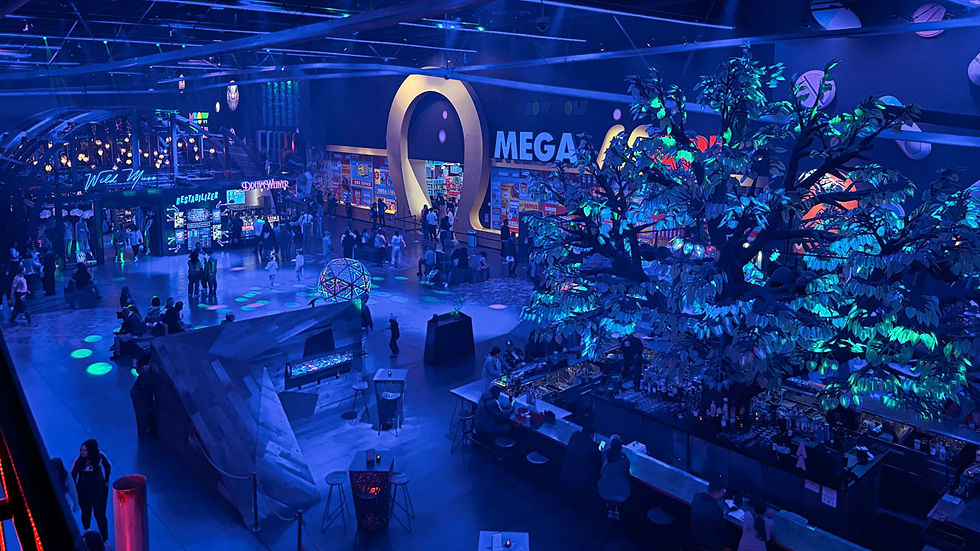
Outside, Art Island features monumental sculptures, including works originally created for the Burning Man festival. A decommissioned Boeing 747 is planned to be repurposed as a future food and event venue.
With the 2025 expansion Zone 2: The Terminals, AREA15 now covers approximately 12 hectares. The new area includes Universal Horror Unleashed by Universal Destinations & Experiences, as well as additional dining and retail spaces.
Immersive Formats: Omega Mart and Illuminarium
Omega Mart by Meow Wolf
The most widely known attraction within AREA15 is Omega Mart, operated by the artist collective Meow Wolf. Spanning more than 4,000 square meters, the installation blends art exhibition, walkable narrative, and spatial disorientation.

Visitors enter through what appears to be a conventional supermarket. Shelves, refrigerators, and products feel familiar at first—until closer inspection reveals the absurd. Product names such as “Tattooed Chicken” or “Cage Free Toes” subtly unsettle expectations.
Hidden doors and refrigerator portals lead into entirely different environments: psychedelic desert landscapes, office spaces of a fictional corporation called Dramcorp, and abstract light-based rooms.
More than 325 creatives contributed to over 250 individual components within the installation. The technological foundation includes projection mapping, generative audio systems, and interactive elements responding to touch and movement. Optional RFID cards unlock additional layers of interaction.
The experience is intentionally non-linear. There is no prescribed route and no explanatory signage. Visitors navigate the space on their own—a design choice that rewards curiosity and active exploration.
Illuminarium
Illuminarium, opened in 2022, follows a different approach. The approximately 3,000-square-meter venue uses large-scale projection, 360-degree audio, floor vibration systems, and scent control to create fully immersive environments—without VR headsets. The rotating programs range from virtual safaris and space journeys to artistic interpretations of natural and abstract worlds. In the evening, the venue transforms into an After Dark lounge, combining nightlife with dynamic visual environments.
Illuminarium exterior at AREA15 Las Vegas Interior of the Illuminarium at AREA15 Las Vegas with large-scale projections Image: Holoplot Illuminated triangular entrance structure at AREA15 Las Vegas with sculptural light design.
The technical infrastructure includes high-resolution 4K Panasonic Projektoren and a Holoplot-X1-Soundsystem. Its 3D audio beamforming technology ensures consistent sound distribution throughout the space, independent of the visitor’s position.
Walking through AREA15, one thing becomes apparent: technology is omnipresent, yet rarely visible. Projectors, sensors, control systems remain in the background. What matters is the effect—the sense of surprise, disorientation, and wonder.
This technical restraint is intentional. Technology serves the experience, not the other way around.
Positioning Between Exhibition, Attraction, and Platform
AREA15 resists easy categorization—and that is by design. It is not a museum, because the exhibits invite interaction. It is not a theme park, despite featuring a zipline-style roller coaster through the Spine. It is not a nightclub, even though DJ sets and concerts are regular occurrences.
The operators describe it as an experiential entertainment district. While the term may sound like marketing language, it captures a key aspect: AREA15 functions as infrastructure. It provides a stage for diverse content creators. Each tenant—Meow Wolf, Illuminarium, Universal Horror Unleashed—brings its own aesthetic, audience, and narrative logic.
Experiential entertainment focuses on active participation rather than passive consumption. It creates memorable moments through immersive storytelling, interactive technologies, and spatial design—often blending digital systems with physical environments to deepen emotional engagement.
Why AREA15 Las Vegas Works as an Immersive Entertainment Format
Several factors contribute to the viability of the concept.
Location: Las Vegas attracts millions of visitors annually, many of whom are looking for alternatives to casinos. AREA15 is close enough to the Strip to remain accessible, yet distant enough to establish its own atmosphere.
Flexibility: The tenant-based model allows for constant renewal. Attractions can be replaced, expanded, or seasonally adapted. Universal Horror Unleashed, for example, regularly introduces new overlays—such as a Krampus-themed edition during the 2025 holiday season.
Accessibility: Free general admission lowers the threshold. Visitors can wander, observe, and absorb the atmosphere before deciding whether to engage with ticketed experiences.
Audience diversity: Omega Mart appeals to art-focused visitors, Illuminarium to families, Universal Horror Unleashed to genre enthusiasts. The illuminated Oddwood bar attracts a nightlife crowd. AREA15 does not fragment audiences—it aggregates them.
Implications for Experience Design and Spatial Storytelling
For professionals in experience design, spatial staging, and immersive environments, AREA15 serves as a tangible reference point. It demonstrates how architecture, lighting, audio technology, storytelling, and retail can merge into a coherent overall experience.
Visitors interacting with a large-scale digital art installation at AREA15 Las Vegas. Visitor playing a classic pinball machine in the arcade area of AREA15 Las Vegas. Visitor engaging with an interactive dodgeball attraction at AREA15 Las Vegas.
Open structures guide movement without enforcing it. Technology amplifies experiences without dominating them.
The economic scalability is equally notable. Planned expansions in Orlando, as well as announced locations in Manchester, Atlanta, and Dallas, suggest that the model is transferable. Anchor tenants, modular infrastructure, and the combination of free and monetized zones form a repeatable framework.
Outlook
AREA15 continues to evolve. The Zone 2 expansion nearly doubled the footprint. New attractions, such as the John-Wick-Experience by Lionsgate , broaden the portfolio. The integration of entertainment franchises—Universal, Superplastic, Rolling Stone—signals increasing convergence with established media brands.
Whether this model represents the future of location-based entertainment remains open. What is clear is that AREA15 functions as a laboratory: a place where formats are tested that do not fit neatly into theme parks, museums, or retail.
For anyone professionally engaged in experience design, immersive formats, or emerging entertainment concepts, AREA15 offers a compelling point of reference—not as a blueprint, but as a framework for thinking.


