
The UGC Brand Activation Playbook: Why Participation Beats Observation

The Most Expensive Business Card in History

There are approximately 11 Formula 1 teams in the world. Owning one requires somewhere between €140 million and €500 million annually, a small army of engineers, and the kind of patience usually reserved for cathedral builders.
Recently, at a business event with Bconnect Heidelberg Marketing, we launched an F1 team of our own. It cost considerably less. It required no wind tunnel. And it lasted exactly one evening.
The “Heidelberg Marketing | epicto F1 Team” was a generative AI activation where guests stepped into the role of racing drivers. Custom cockpit images, professional driver cards, racing lifestyle photography—all created in real time, printed on the spot, and shared across social channels before the main course arrived.
It was fun. It was memorable. But more importantly, it illustrated something that deserves serious attention from anyone responsible for brand strategy: the mechanics of participation have fundamentally changed, and so has the value equation of experiential marketing.
This article explores why UGC brand activation has become a strategic currency, how participatory activations create measurable business value, and what it takes to turn a single event into an extendable marketing ecosystem
The Great Shift: From Audiences to Advocates
For decades, brand events followed a predictable formula: create something impressive, invite people to witness it, hope they remember it fondly.
The relationship was fundamentally passive. Attendees were an audience. The brand performed. Applause was the metric.
That model hasn’t disappeared, but it has been joined—and increasingly overshadowed—by something different: activations designed around participation rather than observation.
The distinction matters because participation changes the psychological contract between brand and guest. When someone creates something, they invest in it. When they share it, they endorse it. When their name or face appears in the content, they become a stakeholder in its success.
This isn’t a soft insight. According to research compiled by Bazaarvoice:
84% of people* are more likely to trust a brand that uses UGC in their marketing campaigns
79% of consumers* say UGC highly impacts their purchasing decisions
UGC posts receive 28% higher engagement* than brand-generated content
People believe other people more than they believe advertisements. This has always been true. What’s changed is the infrastructure for capturing and channeling that belief at scale.
UGC Brand Activation as Strategic Currency
The phrase “user-generated content” often evokes images of spontaneous social posts—unplanned, unstructured, largely outside a brand’s control. That version of UGC certainly exists and has value.
But the more interesting opportunity lies in what we might call designed participation: creating conditions where guests produce content that is simultaneously authentic (it features them, they chose to make it) and strategically aligned (it carries brand messages, visual identity, and narrative structure).
The Heidelberg Marketing | epicto F1 Team activation exemplified this approach:
Every image guests created included consistent brand elements
Every share extended reach into networks the brand couldn’t access directly
Every piece of content was a co-branded endorsement—more credible than advertising precisely because it featured a real person who chose to participate
The mathematics of this approach are compelling:
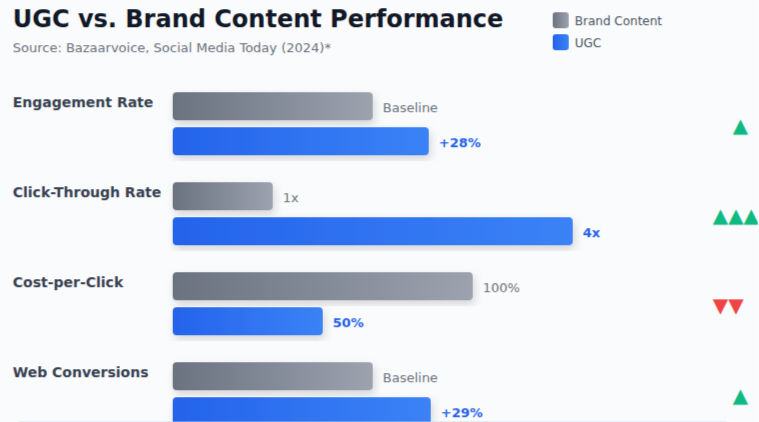
Sources: Bazaarvoice, Social Media Today, WiserNotify (2024) (visualized by claude.ai)
A hundred guests, each sharing to networks averaging several hundred connections, generates reach that would cost substantial amounts to purchase through paid media. More importantly, that reach comes with built-in social proof.
The Anatomy of Shareable UGC Brand Activation Moments
Not all activation content gets shared. The difference between content that dies on someone’s camera roll and content that propagates across networks comes down to a few key mechanics.
1. Identity Expression
The most shareable content allows people to express something about themselves.
Case Study: Spotify Wrapped
Spotify’s annual “Wrapped” campaign transforms user listening data into personalized, visually striking stories that users share by the millions.

Over 156 million users** engaged with Spotify Wrapped in 2022
The campaign generated approximately 630 million social shares** across 56 languages in 2024
App downloads increased 20%** during Q4 2020
The genius isn’t technical complexity—it’s psychological insight. People don’t share their Wrapped to advertise Spotify. They share it to tell the world something about who they are.
2. Quality Threshold
Earlier personalization techniques often produced results that felt cheap or gimmicky—think fairground photo cutouts or basic face-in-hole templates. Current generative tools can produce imagery at a quality level guests are genuinely proud to share. Content that looks amateur doesn’t get shared, regardless of how easy you make the mechanics. According to EventTrack, 98% of consumers create digital or social content at events, with 100% of those sharing the content online**—but only when the output quality meets their standards for public endorsement.
3. Frictionless Delivery
The moment of highest emotional engagement is often the moment of creation. Every second between that peak and the ability to share represents potential loss. Modern activations: - Deliver content via QR code to personal devices - Enable one-tap sharing to multiple platforms - Produce formats optimized for each destination. The goal is to reduce the distance between “that’s amazing” and “shared” to near zero.
Learning from the Best: Global Activation Case Studies
Coca-Cola’s Share a Coke
Perhaps the most celebrated UGC campaign of the past decade, Coca-Cola’s personalized bottle campaign transformed a mass-produced product into a deeply personal item.
What they did: - Replaced the classic Coca-Cola script with popular names - Deployed interactive kiosks at events and music festivals for custom labels - Expanded from Australia (2011) to over 80 countries
Why it worked: The brilliance was making consumers the star of the brand story. The campaign generated millions of social posts as people searched for their names, photographed their bottles, and shared their finds.
The Value Extends Beyond Virality
The reach extension from UGC is significant, but it’s not the only value participatory activations create.
Data Capture Through Value Exchange
Every participation in a brand activation is, potentially, the beginning of a measurable relationship. According to industry research, 75% of B2B brand-side respondents capture data about the audience at events.* The key is designing the exchange so guests receive clear value: their personalized content, delivered to their inbox, in exchange for contact information they willingly provide.
Extended Content Lifespan
Traditional advertising has a brief window of attention. UGC generated through activations continues working long after the event ends. Research from Freeman found that 64% of consumers hold onto positive impressions of brands for one month or longer* after a brand activation or event.
Organic Reach Amplification
Social media engagement for brands using experiential marketing increases by 34%* compared to traditional campaigns. This isn’t paid amplification—it’s the natural result of people sharing content they’re genuinely proud of.
From One-Night Event to Always-On Ecosystem
The most sophisticated brand activation programs think beyond individual events to activation ecosystems: interconnected experiences that build on each other, share data infrastructure, and compound relationship value over time.
Key components of ecosystem thinking:
Component | Description |
Shared Identity Frameworks | Visual and narrative systems that maintain brand coherence across activations |
Common Data Infrastructure | CRM and analytics that aggregate data across touchpoints |
Modular Experience Components | Elements that reconfigure for different venues and audiences |
Cumulative Learning Systems | Processes for capturing and applying insights |
The financial implications are significant: - Setup costs amortized across multiple activations - Learnings captured rather than lost - Audience relationships accumulate rather than reset
Key Takeaways
Participation beats observation: Activations designed for guest participation generate trust, engagement, and reach that passive experiences cannot match.
UGC is a strategic asset: User-generated content drives 28% higher engagement, 4x click-through rates, and 50% lower cost-per-click than brand content.*
Quality enables sharing: Guests only share content they’re proud of. Investment in output quality directly impacts organic reach.
Value exchange enables data capture: Transparent, consent-based first-party data collection builds sustainable marketing assets while respecting privacy.
Think ecosystems, not events: The most valuable activations are building blocks in larger relationship-building infrastructure.
What’s Next?
What’s the most memorable brand moment where you weren’t just watching—you were part of it? And what made it worth sharing?
In Part 2, we’ll explore how modern activations connect to data, CRM, and loyalty ecosystems—ethically and effectively.
Sources
Bazaarvoice. (2024). “64 User-Generated Content Statistics to Know.” https://www.bazaarvoice.com/blog/user-generated-content-statistics-to-know/
CrowdRiff. (2024). “47 Most Important User-Generated Content Statistics.” https://crowdriff.com/resources/ugc-stats/
NoGood. (2024). “Spotify Wrapped Marketing Strategy: Viral Phenomenon.” https://nogood.io/blog/spotify-wrapped-marketing-strategy/
EventTrack. (2024). Cited in Exposure Analytics. https://exposureanalytics.com/blog/5-experiential-event-statistics-to-inspire-your-next-event/
Freeman. (2024). “Freeman Trends Report: Attendee Intent and Behavior.” https://www.freeman.com/about/press/freeman-launches-new-attendee-intent-and-behavior-trend-report/
Theory House. (2025). “7 Inspiring Brand Activation Examples.” https://www.theoryhouse.com/blog/brand-activation-examples
Meltwater. (2025). “How Spotify Wrapped 2025 Went Viral.” https://www.meltwater.com/en/blog/spotify-wrapped-listening-age-analysis
*Secondary Sources & Reports: Bazaarvoice, Freeman, Statista, Forrester
**Individual Sources & Reports: Spotify Wrapped metrics, EventTrack, Topgolf case study


