
The Invisible Fan Problem: Why Sports and Brands Are Leaving Billions on the Table

Updated: Jan 25
Part 1 of 5: The Data-Driven Future of Fan Engagement and Sponsorship
Consider a striking paradox: FC Barcelona claims estimated 350 million fans worldwide, yet the club has meaningful data on fewer than 1% of them. Real Madrid counts 600 million supporters, but until recently could identify barely a fraction through direct relationships. This is not an anomaly. It is the norm across professional sports.

A January 2026 study by Dizplai, surveying senior sports industry executives, found that 76% of sports fans remain anonymous to the organizations they support. Rights holders estimate this anonymity costs them between $1 million and $5 million annually in unrealized revenue, with 62% of leaders believing they lose more than $100,000 yearly simply because they cannot identify, reach, or monetize their audience (Dizplai, 2026).
For brands investing in sports sponsorships, the implications are equally sobering. You are paying premium prices for access to passionate audiences, yet the infrastructure to prove that investment delivers measurable business outcomes often does not exist. This is not a minor inefficiency. It represents a fundamental misalignment between how the sports industry operates and what modern marketing requires.
The Conversion Gap No One Talks About
The gap between reach and revenue in sports is staggering. TIAKI Sports Consulting estimates the conversion rate from social media followers to actively transacting fans—season ticket holders, regular merchandise buyers, or paid content subscribers—sits at just 0.5% to 2% across the sports industry (TIAKI Sports Consulting, 2024). To put this in perspective: The median conversion rate across all industries is just 6.6%, with ranges from 3.8% to 12.3% depending on sector (Unbounce 2024)
A club with 50 million social followers may have fewer than 1 million fans in its database with actionable contact information. The remaining 49 million are, from a commercial standpoint, invisible. They generate vanity metrics but not revenue. They cannot be segmented, personalized to, or offered to sponsors as a verified, targetable audience.
This conversion gap exists because most sports organizations lack unified data infrastructure. N3XT Sports' digital maturity study found that while 88.6% of sports organizations collect first-party data on their websites, only 54.4% do so via mobile applications, 65.1% through e-commerce platforms, and 69.9% via ticketing systems (N3XT Sports, 2024). The result is fragmented data across dozens of disconnected systems.
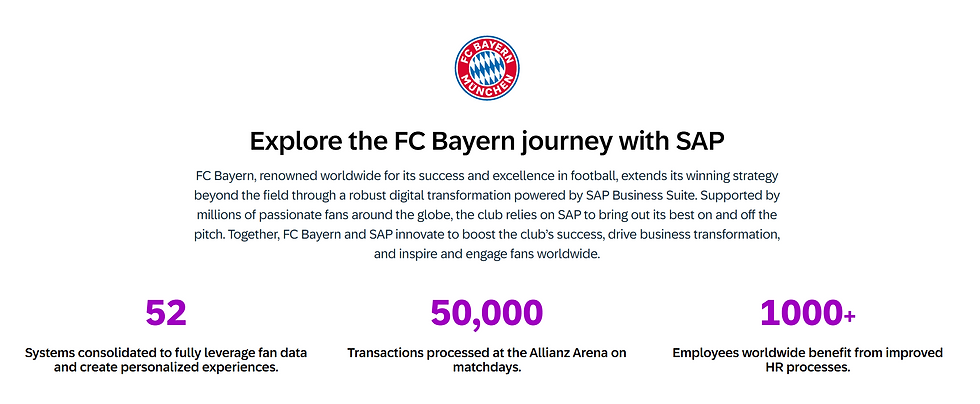
Bayern Munich, before its digital transformation, operated with 52 separate databases. Each touchpoint knew something about the fan; none knew the complete picture.
The Sponsorship Measurement Crisis
Sponsorship represents approximately 15% of the average marketing budget, yet it remains poorly measured relative to other marketing investments. Nielsen Sports research reveals a 68% potential error rate in sponsorship ROI calculations when brands attempt measurement using inaccurate data or flawed models (Nielsen Sports, 2023).
The measurement challenge is pervasive. Industry surveys indicate that 40% of sponsors spend less than 1% of their sponsorship budgets on measurement and evaluation, and over 25% spend nothing at all. Only 19% of sponsorship professionals express confidence they can measure business value, and just 33% of businesses have a standardized measurement process (European Sponsorship Association, 2023).
This creates a credibility gap that hurts both sides. Sponsors struggle to justify investments internally, leading industry reports indicate 74% of brands to reduce their sponsorship portfolios in 2024, consolidating into fewer, more measurable relationships. Rights holders, meanwhile, struggle to demonstrate value beyond impressions and logo exposure—metrics that increasingly fail to satisfy CFOs demanding attribution and return on investment. LaLiga President Javier Tebas has articulated the coming shift with unusual clarity:
There will be a radical change when it comes to sponsors. They won't only ask to be showcased. Being on the shirt, on the television, and on the advertising boards will lose value, and what will have much more value will be the delivery of organized, segmented, and useful data (LaLiga, 2024).
The True Cost of Non-Personalized Engagement
The financial impact of failing to personalize fan engagement is now quantifiable. McKinsey's research on personalization across industries found that companies excelling at personalization generate 40% more revenue from those activities than average performers. Personalization drives 10–15% revenue lift on average, with top performers achieving significantly more (McKinsey, 2021).

BCG's research with Google on first-party data activation found that brands using first-party data for key marketing functions achieve up to 2.9x revenue uplift and a 1.5x increase in cost savings. Companies that link all first-party data sources generate double the incremental revenue from a single ad placement compared to those with fragmented data (BCG/Google, 2020).
Research on emotional brand connection demonstrates that emotionally connected customers have 306% higher lifetime value than satisfied but unconnected customers—staying with brands 5.1 years versus 3.4 years on average, and recommending at rates of 71% versus 45% (Motista, 2018). In sports contexts, team identification research confirms that emotional attachment drives significantly higher consumption behaviors (Frontiers in Psychology, 2022).
For sports organizations, where emotional connection is the core product, failing to capture and activate this connection represents an extraordinary missed opportunity.
PwC's 2024 Global Sports Survey captured the paradox succinctly: most brands generate over 80% of their insights from only 20% of their customers, and many sports properties lack any meaningful insight into non-attending fans, particularly those based overseas. This means the vast majority of a global fanbase—often the most commercially valuable segment for sponsors seeking international reach—remains effectively invisible.
What This Means for Decision-Makers
The evidence points to a structural problem, not a tactical one. The fan data gap is not the result of insufficient social media activity, inadequate content production, or poor creative execution. It stems from fundamental choices about data architecture, technology investment, and commercial strategy that most sports organizations made—or failed to make—over the past decade.
For sports organizations, the 76% anonymity rate represents both the problem and the opportunity. Those figures are not destiny.

Real Madrid expanded its data sources from 5 to 70 and improved fan conversions by 60%.
LaLiga grew its audiovisual income from €840 million to €2.1 billion by building data infrastructure that makes the competition more valuable to broadcasters and sponsors alike.
Formula 1 doubled its revenue from $1.7 billion to $3.65 billion in seven years through a systematic strategy of digital engagement, content distribution, and direct-to-consumer relationships.
For brands and sponsors, the measurement crisis demands a new approach to partnership evaluation. The 68% error rate in ROI calculation is not acceptable for 15% of a marketing budget. Sponsors who continue accepting impressions and media value equivalency as primary metrics are operating with measurement standards a decade out of date. The shift Tebas describes—from logo exposure to data delivery—will separate sophisticated sponsors who extract real value from those who subsidize sports properties without commercial return.
Key Takeaways on the Invisible Fan Problem
The anonymity problem is quantified: 76% of fans remain unknown to sports organizations, costing $1–5 million annually in unrealized revenue per rights holder (Dizplai, 2026). This is not inevitable; it reflects underinvestment in data infrastructure.
Conversion rates expose the gap between reach and revenue: Sports converts social followers at 0.5–2%, significantly below the cross-industry median of 6.6% (Unbounce, 2024) (TIAKI, 2024). Closing this gap requires unified data systems, not more content.
Sponsorship measurement is fundamentally broken: A 68% potential error rate in ROI calculations (Nielsen, 2023) makes sponsorship the least accountable major marketing investment. Brands consolidating portfolios are responding rationally to this credibility gap.
First-party data activation delivers proven returns: Up to 2.9x revenue uplift and 1.5x cost savings (BCG/Google, 2020). Organizations that unify data sources double incremental revenue from marketing activities.
Emotional connection has quantifiable lifetime value: 306% higher CLV for emotionally connected versus merely satisfied customers (Motista, 2018; supported by Frontiers in Psychology, 2022)
Next in this series: We examine how leading organizations—from Real Madrid to Formula 1 to the NFL—have solved the fan data gap and what measurable results they've achieved.
Sources
BCG/Google (2023). Responsible Marketing with First-Party Data. https://www.bcg.com/publications/2020/responsible-marketing-with-first-party-data
Deloitte (2025). Football Money League 2025. https://www.deloitte.com/uk/en/about/press-room/real-madrid-tops-deloitte-football-money-league.html
Dizplai/WSC Sports (2026). Closing the Gap Between Reach and Revenue. https://wsc-sports.com/blog/industry-insights/closing-the-gap-between-reach-and-revenue-how-ai-powered-content-unlocks-fan-value/
European Sponsorship Association (2023). Nielsen Global Sports Marketing Report. https://sponsorship.org/nielsen-releases-2022-global-sports-marketing-report/
FC Bayern Munich / SAP (2024). Customer Success Story. https://www.sap.com/about/customer-stories/fcbayern.html
Frontiers in Psychology (2022). Team Identification and Consumption Behaviors: A Meta-Analysis. https://www.frontiersin.org/journals/psychology/articles/10.3389/fpsyg.2022.869275/full
LaLiga (2024). Tebas: Time for sports industry to improve its use of data. https://newsletter.laliga.es/global-futbol/tebas-data-in-the-sports-industry-laliga
Liberty Media / Arthnova (2024). How Liberty Media Made F1 Profitable. https://arthnova.com/how-liberty-media-made-f1-profitable/
McKinsey & Company (2021). The value of getting personalization right—or wrong—is multiplying. https://www.mckinsey.com/capabilities/growth-marketing-and-sales/our-insights/the-value-of-getting-personalization-right-or-wrong-is-multiplying
N3XT Sports (2024). Assessing European football's federation data & digital benchmarks. https://www.n3xtsports.com/insights-uefa-euro-2024-digital-transformation-fan-data/
Nielsen Sports (2023). Return on Sponsorship Investment. https://nielsensports.com/return-on-sponsorship-investment/
Real Madrid / Silicon UK (2024). How Fan Data Is Keeping Real Madrid The Kings Of Europe. https://www.silicon.co.uk/data-storage/real-madrid-digital-223105
TIAKI / Tappit (2024). A first-party data strategy is key to fan engagement. https://tappit.com/resources/blog/a-first-party-data-strategy-is-key-to-fan-engagement
Harvard Business Review / Motista (2016). The New Science of Customer Emotions.* https://hbr.org/2015/11/the-new-science-of-customer-emotions


